
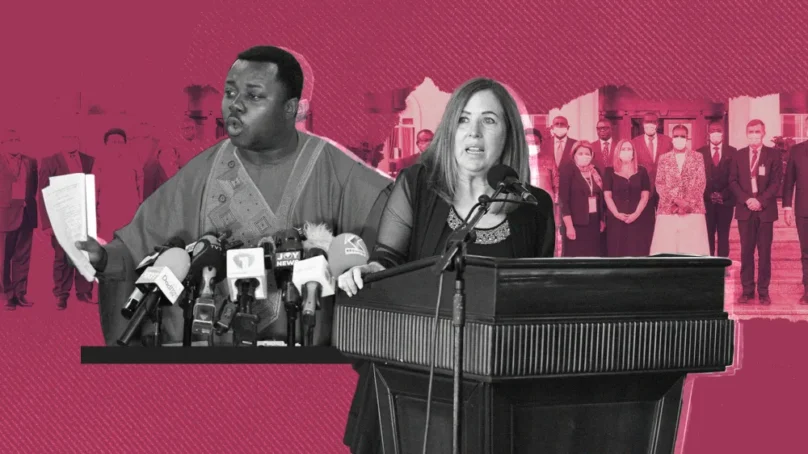
In December 2022, Sharon Slater, president of an Arizona-based conservative Christian organisation called Family Watch International, signed a memorandum of cooperation with the International Islamic Fiqh Academy – one of the highest jurisprudential authorities in Sunni Islam – at its headquarters in Jeddah, Saudi Arabia.
Slater is a Mormon whose organisation has been designated a hate group by the Southern Poverty Law Centre. In a release on the academy’s website, Slater described the mission of her organisation as protecting “the family institution in accordance with what all divine laws called for”, and praised the partnership as a vehicle for rallying religious institutions across faiths to that cause.
This week, Slater’s organisation will co-convene the 4th African Inter-Parliamentary Conference on Family and Sovereignty in Accra, Ghana, a gathering that rights organisations have warned serves as a platform for advancing anti-LGBTQ legislation across the continent.
It comes as no surprise then that Ghana’s parliament hurriedly passed an anti-LGBTQ bill on May 29, one that stipulates an up-to-10-year jail term for “promoting” LGBTQ activities and includes an extradition clause for queer Ghanaians abroad. The bill, which now awaits presidential assent, enjoys the support of the Ghana Catholic Bishops’ Conference, the Christian Council of Ghana and the Office of the National Chief Imam.
The influence of US evangelical Christianity on anti-LGBTQ legislation across Africa has been extensively documented over the past two decades. In 2023, I wrote about US architectural influence on Uganda’s anti-homosexuality law, which passed weeks before the first African Inter-Parliamentary Conference on Family and Sovereignty in Entebbe, Uganda.
My goal now, though, is to examine something that has received far less scrutiny: the cross confessional coalition that makes these movements possible. By that, I mean the deliberate alliance between Christian, Muslim and even traditional religious institutions – groups with largely incompatible theologies – that has been made politically operational in Africa through the deliberately secularising language of “family values”.
The same rhetoric has been used in a related pushback on women’s rights more broadly, and sexual and reproductive health rights specifically.
That this week’s “family values” conference is taking place in Ghana is not incidental. It is, in many ways, one such African laboratory where the cross-religious model was first formalised and tested.
In 2013, Ghanaian lawyer and anti-LGBTQ activist Moses Foh-Amoaning founded the National Coalition for Proper Human Sexual Rights and Family Values as a deliberately tripartite body. It unites the Christian Council, the Catholic Bishops’ Conference, the Pentecostal-Charismatic Council, Muslim organisations and the National House of Chiefs under a single structure.
By 2019, at a World Congress of Families summit in Accra that featured Muslim and traditional leaders as speakers, Foh-Amoaning was openly calling this arrangement the “Holy Trinity”. Over the following years, the coalition became one of the most influential anti-LGBTQ forces in Ghana, helping mobilise support for the closure of an EU-backed LGBTQ community centre in Accra, organising national prayer events against homosexuality and camps to cure homosexuality, and eventually backing the legislation that passed last week.
Ghana thus is an early proof of concept for how Christian, Muslim and traditional institutions could be assembled into a single political constituency through the language of “family values”.
It is crucial to poke at this coalition and understand its mechanisms because we can then start to see connections between what’s happened in Ghana and Uganda – which are majority Christian – to places like Senegal, which also recently passed a new anti-LGBTQ law, Burkina Faso, which passed a law last year, and Mali, which criminalised homosexuality in 2024 – all majority-Muslim countries.
A recent investigation by Reuters revealed that MassResistance, a US-based Christian nationalist organisation, worked directly with And Sàmm Jikko Yi, a Senegalese network of Islamic organisations, to push for the new law. In fact, it was And Sàmm Jikko Yi that contacted MassResistance to discuss strategy, mobilisation, and the possible creation of a MassResistance chapter in the country. MassResistance has also been documented as a supporter of Ghana’s anti-LGBTQ bill.
Yet even as this coalition reaches its maturation in this present moment, it is a collaboration that has been years in the making.
In 2010, at the now infamous “eat da poo” conference where Ugandan pastor Martin Ssempa went on a graphic tirade about homosexuality, he was flanked by Christian and Muslim leaders. Months earlier in 2009, Ssempa had announced on his blog the formation of a national coalition between Christians and Muslims to fight homosexuality, united, as he put it, by “common desire… regardless of our religious and denominational differences”.
In 2023, when Uganda’s Inter-Religious Council held a press conference demanding the return of the anti-homosexuality bill, the Mufti of Uganda sat alongside the Archbishop of the Church of Uganda, a Catholic bishop and leaders of the Born Again and Seventh Day Adventist churches. Weeks later, the bill – which recommended the death penalty for homosexuality – was introduced in parliament, sponsored by a Muslim MP, Asuman Basalirwa.
What I am trying to surface by digging into this history is not only the apparent collaboration between Christian and Muslim institutions against LGBTQ rights – that much is visible to anyone paying attention.
Instead, I would argue that these collaborations mark the beginning points of a movement in which Islamic institutions in Africa have evolved from passive instruments in a US Christian nationalist strategy to active co-architects of it.
Whose “family values”?
The vehicle for this evolution is the “family values” framework, a phrase that functions as a translation protocol, allowing groups with many incompatible theologies to interoperate politically.
It succeeds as a binding agent because it does not require theological agreement. It allows Christianity, Islam, and traditional African religions to each be positioned as vehicles of indigenous cultural defence against secular liberal globalism.
The Inter-Parliamentary Conference on Family and Sovereignty taking place in Accra this week is one where we see this reflected very clearly. It is the fourth edition of a “family values” gathering that began in Uganda in March 2023, co-convened by Family Watch International and the African Bar Association.
One of the conference’s central ambitions is the adoption of a proposed African Charter on Family Values and Sovereignty, a continental legal instrument that would codify a unified set of “African family values” and present them to heads of state for adoption.
The groundwork for that ambition has been laid over several years. The first conference drew delegates from over 22 African countries. By the second, in 2024, the Speaker of The Gambia’s National Assembly – an overwhelmingly Muslim legislature – was in attendance, alongside an Egyptian MP. By the third, in 2025, 29 countries were represented, and Morocco had pledged support for the proposed charter.
It seems evident that as the US Christian right carried out its anti-homosexuality campaign in majority-Christian countries in the mid-2000s, it became clear that Christianity alone as a moral claim against LGBTQ rights could not achieve continental reach. The movement needed a translatable framework that would land irrespective of religious beliefs if they wanted to export continentally.
The “family values” container thus does that work of inclusion precisely by being theologically empty: It is a secular shell around a Christian right project that needs Muslim (and other) bodies in the room to claim continental legitimacy.
One cannot claim to speak for a continent of 54 countries, multiple legal traditions and vast religious diversity with a framework rooted in any single theology. Yet the proposed charter’s central conceit is precisely that there exists a singular set of African “family values” that can be codified into law. The irony is difficult to miss: A movement that presents itself as resisting Western cultural imperialism relies on a vision of Africa that is itself profoundly colonial.
That is not the only irony of the coalition. Many of the Western organisations that have helped build this cross-confessional architecture in Africa remain aligned, in their domestic contexts, with movements deeply hostile to Islam.
The World Congress of Families, which organised the 2019 Accra summit where the “Holy Trinity” model was showcased, has documented ties to Islamophobic, far-right and white supremacist movements in Europe – allies who have called African migrants “slaves” and “poison”.
The “family values” label launders a contradiction that would be immediately visible to the movement’s Muslim partners if they looked closely enough at who their allies are when they are not in Africa.
This week’s conference in Accra, then, should not be understood as just another event in the well-documented pipeline of US-exported homophobia. It represents the culmination of an inter-faith coalition model that is, remarkably, more advanced in Africa than anywhere else in the world, including the United States.
The proposed “African values” charter is not the end-point of that effort but it might be the clearest indication yet that the effort is only beginning. It is important that we recognise that cross-confessional model for what it is, be aware that it is not finished, and begin to interrogate what it might do next.
- A Tell Media report / Source: The New Humanitarian


About author