

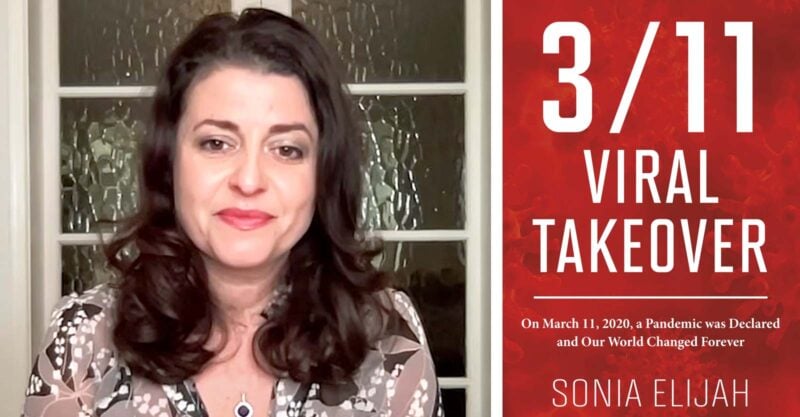
In her new book, 3/11 Viral Takeover: On March 11, 2020, a Pandemic was Declared and Our World Changed Forever, investigative journalist Sonia Elijah explores how Covid-19 information was shaped from the outset: “the censorship begins from the beginning.”
In an April 19 interview, Elijah told John Campbell, that her book draws on five years of reporting, including reviews of documents, emails, scientific papers and whistle-blower accounts.
The book title points to the day the World Health Organization declared Covid-19 a global pandemic. Elijah said that moment accelerated and formalised a unified narrative across institutions, media and technology platforms, shaping what could – and could not – be said.
She traced the messaging to the earliest weeks of the crisis, before the declaration, when key positions were already taking hold.
A February 2020 statement published in The Lancet declared, “We stand together to strongly condemn conspiracy theories suggesting Covid-19 does not have a natural origin.” Elijah said the statement reflected the authors’ conflicts of interest. “If you look at that joint Lancet statement, I think … 26 out of the 27 scientists involved had links with the Wuhan Institute of Virology … or its funders,” she said. “Isn’t that very telling?”
The statement also helped set the tone for dismissing dissent, according to Elijah.
“You have a crackdown completely dismissing the natural origin of the virus,” she said. Anyone who questioned it was “labelled as a conspiracy theorist.”
Throughout her book, Elijah documents how institutions collaborated to reinforce an approved narrative while side-lining alternatives. She cited examples of withdrawn or retracted studies, including research on early treatments and vaccine safety signals.
One published study examining myocarditis risk in younger males “was forcibly withdrawn” just days before a vote by the US Food and Drug Administration (FDA) on authorising the Pfizer vaccine for children ages 5-11, Elijah said.
“It was a pivotal study that could have made a difference if it had lived,” she said.
She also raised concerns about overlapping roles across institutions.
“You had Dr Eric Rubin … editor of the New England Journal of Medicine, who also sits … on the FDA board, saying we won’t know if the vaccine is safe until we roll it out,” Elijah said. “Essentially, the public were used as guinea pigs.”
Her reporting also focused on the treatment of early Covid-19 therapies. Elijah described a “multipronged” effort to discredit drugs such as hydroxychloroquine and ivermectin, including an FDA tweet saying, “You are not a horse.”
These efforts occurred alongside regulatory decisions that restricted use of the drugs. She linked those moves to the requirements for emergency use authorisation of vaccines.
“One of the conditions … was that there was no existing treatment for Covid-19,” she said. “You can’t have a cheap generic drug … being an effective treatment for … Covid-19. We have to wait for this saviour vaccine to come about.”
Elijah also questions how Pfizer safety data was handled. She pointed to internal reports and advisory discussions that listed potential adverse events – including strokes, seizures and myocarditis – before vaccine rollouts.
“It was on their radar. They knew about it months prior,” Elijah said.
She also cited other internal company documents, including a pregnancy and lactation review. Elijah said the review detailed “all the harms” to pregnant women and infants and was finalised shortly before public health agencies expanded their recommendations to promote the shots for pregnant women.
The vaccines were “far, far from safe,” Elijah said.
Elijah acknowledged that regulators relied on publicly available data, not internal company documents, but argued that key information wasn’t disclosed.
“They didn’t do their due diligence,” Elijah said. “They enabled the pharmaceutical industry to get away with many crimes.”
Beyond scientific and regulatory decisions, the book examines how information was circulated and controlled. Elijah described governments, legacy media and technology platforms “all sort of coordinating together” through efforts such as the Trusted News Initiative (TNI).
TNI was launched in 2019 “to tackle challenges of disinformation,” according to its website.
“It’s what they deem … misinformation,” Elijah said. “And it’s only their approved narrative that’s allowed to be told.”
Elijah cited the BBC’s role as head of TNI. She described instances in which the BBC admitted to monitoring user behaviour on social platforms such as Facebook to silence accounts spreading what it deemed to be vaccine disinformation.
“This is the coordination. This is the network,” she said. “It’s all coming together to go after these groups to censor them.”
That effort narrowed the range of permissible views online and led to the removal of content on topics such as natural immunity and vaccine side effects. She also pointed to ties between media and industry – including connections to Pfizer – as evidence of “capture” across institutions.
“James C. Smith, who’s on Pfizer’s board, is also on the board of Reuters,” Elijah said. So many news broadcasters’ ads are “brought to you by Pfizer. … There is no independent media.”
Throughout the book, Elijah argued that fear shaped public response. She called it “the key tool” that discouraged scrutiny and encouraged compliance with policies from lockdowns to vaccine mandates to digital health passes.
“You arrest people’s critical thinking skills. You make them so afraid, they are willing to do anything,” she told Campbell. She said her goal “is to wake people up … to not be afraid.”
The book includes 941 references, which Elijah said reflect its core premise. “The antidote to all of this is knowledge and truth. When you have that, you don’t need to be afraid,” she said.
She stressed that the book is based on research and evidence, not conjecture. “It’s up to the reader to decide,” she said. “I’m just documenting. I’m chronicling. And I’m doing the investigative journalism that should have been done.”
Campbell echoed that critique of mainstream coverage. “A free press is essential for a free functioning democratic society, and we don’t have it,” he said.
Looking ahead, Elijah warned that control over information could intensify. “We are going to see this control of the internet … because the truth spreads,” she said. “And they don’t want the truth spreading.”
- A Tell Media report / By Jill Erzen – Associate editor for The Defender


About author