


US President Donald Trump on Saturday signed an executive order to speed up reviews of certain psychedelic drugs, including ibogaine, which remain in the US federal government’s most restrictive category for illegal, high-risk drugs.
The move has drawn support from some patient groups, veterans and advocates who see substances such as psilocybin, MDMA and ibogaine as promising alternatives to traditional therapies.
Ibogaine and other psychedelics remain banned under the federal government’s most restrictive category for illegal, high-risk drugs. But the administration is taking steps to ease restrictions and spur research on using the drugs for medical purposes, including conditions like severe depression.
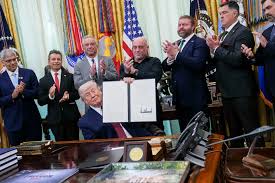
“Today’s order will ensure that people suffering from debilitating symptoms might finally have a chance to reclaim their lives and lead a happier life,” Trump said as he signed an executive order on the drugs. The Republican president said his directive will help “dramatically accelerate” access to potential treatments. “If these turn out to be as good as people are saying, it’s going to have a tremendous impact,” he said.
Critics warn that the rapid push raises a series of concerns, ranging from whether the science is mature enough to whether the process could weaken long-established drug safety standards and whether political influence is playing an outsized role in shaping public health policy.
Scientific uncertainty
Supporters of psychedelic-assisted treatment often point to early-stage studies showing that substances such as psilocybin and MDMA may help patients with severe depression, PTSD and anxiety. Several clinical trials have suggested that psychedelic-assisted therapy could produce faster and more durable effects than some conventional antidepressants, especially for patients who have failed to respond to other treatments.
However, many researchers caution that the current evidence remains limited as most psychedelic studies have involved relatively small groups of participants, making it difficult to determine whether the results can be applied to a broader population.
Researchers have also warned that the long-term effects of repeated psychedelic use remain unclear. Trump said the United States would dedicate $50 million to federal research into ibogaine, which has raised particular concerns among experts.
No psychedelic has been approved in the United States but a number of them are being studied in large trials for various mental health conditions, including psilocybin, MDMA and LSD. All those drugs remain illegal, classified as Schedule I substances alongside drugs such as heroin. Two states – Oregon and Colorado – have legalized psychedelic therapy with psilocybin.
Ibogaine was first used by members of the Bwiti religion in African nations like Gabon during their religious ceremonies. In recent years, US veterans have reported benefiting from the drug after traveling to clinics in Mexico that administer it.
“It’s been incredibly difficult to study ibogaine in the US because of its known cardiotoxicity,” Frederick Barrett, director of the Johns Hopkins Centre for Psychedelic and Consciousness Research, said.
“If the executive order can pave the way for doing objective, scientific research with this compound, it would help us understand whether it is truly a better psychedelic therapy than others,” he added.
Weakening strict drug approval process
Another source of controversy is the concern that the Trump administration’s effort to speed up approvals may weaken the traditionally cautious US drug review process. Trump administration officials have called for faster pathways for psychedelic therapies, including broader use of Right to Try laws created with the intent to allow terminally-ill patients access to experimental therapies and priority review measures.
The Food and Drug Administration (FDA) is set to issue national priority vouchers for three psychedelic drugs next week, marking the first time the agency has extended such fast-track treatment to psychedelics, according sources.
FDA Commissioner Marty Makary said the vouchers would allow certain drugs to be approved more quickly if they align with US national priorities. The mechanism could shorten the review process from several months to just a few weeks.
Critics warned that if psychedelic drugs are approved too quickly, it could undermine public trust in the FDA, suggesting that psychedelic drugs should be held to the same scientific standards as any other medicine.
Political impact
The debate over psychedelic drugs has also taken on a strong political dimension. In December 2025, Trump signed an executive order backing research into marijuana and cannabidiol, also substances classified as illegal. The order instructed US Attorney General Pam Bondi to move ahead with reclassifying marijuana, a decision that would represent one of the most significant federal changes to marijuana policy in decades, said Reuters. Trump’s push for reviews of psychedelic drugs has received backing from veterans’ advocacy groups, which represent more than 17 million people.
Morgan Luttrell, a military veteran and member of Congress who attended Saturday’s signing ceremony, said previous efforts to advance related legislation in Congress had failed. “We will continue working in Congress to build on the president’s leadership and expand access to this life-saving treatment,” he said. “Our veterans answered the call for us. Now we must deliver for them.”
Backing from veterans groups and former Texas Governor Rick Perry led to a law last year providing $50 million for ibogaine research in that state. Perry, who co-founded a group called Americans for Ibogaine, recently appeared on Rogan’s podcast, making the case for reducing federal limits on the drug. It was his second time talking about ibogaine on the popular podcast in the past two years.
Trump’s order calls on the Department of Health and Human Services to direct at least $50 million to states that have enacted or are developing programs to advance psychedelic drugs for serious mental illness. It’s described as a federal-state partnership to provide funding, technical assistance and data sharing.
- A Tell Media / Xinhua report


About author