



Prices of daily groceries have surged in Ethiopia due to higher transport costs linked to the conflict in the Middle East as the country’s Orthodox followers prepare to celebrate Easter on Sunday.
Ethiopia follows the Eastern Orthodox calendar, different from the widely used Gregorian calendar. In the East African country, Easter comes after a 55-day fasting from animal products, mainly meat, milk, butter and eggs.
The holiday is celebrated with a series of events, including the slaughter of sheep, goats or oxen, depending on the financial capability of a household. Adamu Yohannes is one of the onion wholesalers in Merkato, a large open-air market in Addis Ababa, the capital of Ethiopia.
The onions he bought for the holiday market from Humera, nearly 900 kilometres north of Addis Ababa, arrived at Merkato four days late due to fuel shortage along the route, causing them to rot and leading to heavy losses for him.
“A significant portion of my onions loaded on different vehicles went rotten due to exposure to sunlight, humidity and rain while transporting to Addis Ababa. The trucks spent more days than before due to fuel shortage,” Yohannes said in an interview.
According to onion traders, the conflict in the Middle East has raised transportation costs to more than 250,000 birr (about $1,600) per freight from 70,000 birr. Getahun Bekalu, 26, is a long-haul truck driver who transports agricultural products, including onions.
Bekalu said the sweeping fuel rationing introduced by the government has forced him to spend several more days before arriving in Addis Ababa.
“Truck drivers were allowed to buy only 200 litters of diesel oil from a petrol station.
With the 200 litres of diesel, I could only travel about 200 kilometres. Then, I had to queue once again to refuel before heading to the next town. I takes long to drive to Addis Ababa – four more days than I used to,” Bekalu said.
Hundreds of trucks loaded with onions and other agricultural products are still stranded in towns along the route while waiting to refuel. Bekalu said the fuel shortage has, in some circumstances, led to disputes between drivers and wholesalers after the latter received rotten products.
The situation has also left consumers in dismay as onions, integral to holiday meals in Ethiopia, are sold at 100 birr per kilogramme in Merkato and other places in the city. Had it not been for the high transportation costs triggered by the conflict in the Middle East, the price of onions per kilogram would have been 30 birr, thanks to the bumper harvest this year, according to local traders.
The fuel crisis has also resulted in higher transportation costs for cattle, which in turn increases the price of an ox by about 40 per cent compared to three months ago.
“I paid 15,000 birr per ox to bring them from Gojjam, about 400 kilometres away from Addis Ababa. The transportation cost has triple compared to the cost in the previous holiday,” Mesfin Wolde, an oxen trader, lamented.
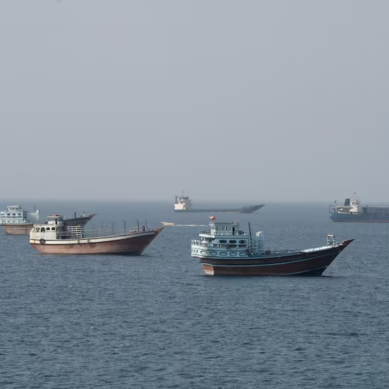
Prices of chicken, sheep and goats have also seen at least a 30 per cent rise due to increasing transport costs. Ethiopia, like many other East African countries, relies heavily on fuel and basic commodities transported through the Strait of Hormuz, a vital, narrow waterway in the Middle East.
Soaring fuel prices have exacerbated inflation in the country and eroded the purchasing power of its citizens.
- A Tell Media / Xinhua report


About author