

In 2000, Uganda made a historic and audacious decision: it became the first country in Africa to formally embrace globalisation as the primary pathway to development for the 21st century and beyond, predating the African Union’s similar adoption in 2002.
Yet two decades later, a troubling question confronts every Ugandan: has the global village delivered on its promises of inclusive prosperity or has it merely masked a deepening crisis in which politics has systematically consumed and distorted development?
This article argues that Uganda stands at a critical crossroads. On one hand, the country has recorded impressive macroeconomic indicators: GDP growth averaging 6-7 per cent annually, per capita income rising from $1,159 to $1,263, and a steady climb in the Human Development Index to 0.582, ranking 157th out of 193 countries.
On the other hand, the Ugandan people confront a sobering reality: 30 per cent live below the poverty line, less than 25 per cent of children complete primary school, only 6 per cent finish advanced level education, and multidimensional poverty in rural areas stands at 50 per cent – nearly three times the urban rate.
The gap between political rhetoric and lived experience has never been wider.
Uganda’s development trajectory has been hijacked by a political logic that prioritises regime survival, family consolidation and elite accumulation over the genuine transformation of the lives of ordinary citizens.
This article dissects the mechanisms through which this capture has occurred – from the ideological consolidation at Kyankwanzi to the militarisation of politics, from the politicisation of development programmes to the emergence of what can only be called the “povertisation” of development.
It concludes by proposing new development paradigms and institutional forms adequate to the challenges of the 21st century and beyond.
Nature of Ugandan politics: conquest, occupation and ideological consolidation
Uganda’s politics has never been a neutral arena for the contestation of ideas and the peaceful alternation of power. Rather, as I have previously argued, it is a politics of conquest, occupation and penetration – both physical and intellectual. At the heart of this system stands the Kyankwanzi National Leadership Institute (NALI), which has been transformed from a putative national ideological centre into an instrument for the National Resistance Movement’s (NRM) determination to entrench itself at the centre of partisan ideological consolidation.
Every newly elected NRM Member of Parliament is required to undergo a week-long induction at Kyankwanzi before being sworn in. Critics have described this ritual as a process of being “proselytized into Musevenocracy” – a diluted brand of democracy contrary to Western conceptions, where MPs become “yes‑men and women to the whims of the kleptocratic gerontocracy”.
This is not political education; it is ideological indoctrination designed to ensure parliamentary loyalty to the presidency above all else.
Politicisation of development
The politicisation of development occurs when development becomes a means of consolidating political power rather than addressing structural inequalities or meeting citizens’ needs. Governments may channel public goods and services – roads, electricity, education, agricultural inputs – towards regions or communities that offer electoral support, while opposition-aligned areas are neglected or receive only minimal services, reinforcing political marginalisation.
In Uganda, this dynamic is not accidental but structural. Development funds are allocated to districts not based on need or planning metrics but on political loyalty. Planning authorities, investment bodies, and regulatory agencies, although intended to function with technical autonomy, are frequently influenced by political appointments, informal networks and patron‑client relationships.
The result is that public goods are perceived by citizens not as rights but as favours from the political elite.
Deceptive development and the GDP mirage
The government frequently celebrates Uganda’s GDP growth – from $3.9 billion in 1986 to $61.3 billion in 2025 – as evidence of successful development. Yet this celebration conceals a deeper crisis. As opposition leader Dr Kizza Besigye has argued, the country’s problems – including poverty, high school dropout rates, unemployment, poor teacher remuneration, inadequate healthcare, corruption, and low capitation grants – require urgent attention that cannot be postponed by GDP statistics.
This is what I term deceptive development: growth that produces nothing of lasting value for the majority while extracting everything from them. It is development that consumes people, communities, and nature without regenerating them. The Civil Society Budget Advocacy Group (CSBAG) described 2025 as a year of “profound economic contradictions”. As Julius Mukunda, CSBAG’s executive director, stated: “The major interrogation is no longer whether Uganda can grow, but whether that growth is translating into tangible improvements in the lives of ordinary Ugandans”.
Militarised politics and hereditary succession
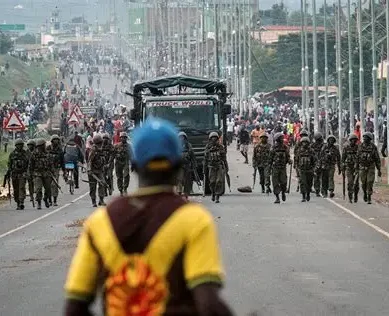
The militarisation of Uganda’s political landscape has reached alarming proportions. A new report by the Great Lakes Institute for Strategic Studies and Innovations for Democratic Engagement and Action warns that the Uganda People’s Defence Forces (UPDF) has moved from the barracks into the boardrooms of national decision-making. The 1995 Constitution’s promise that “power belongs to the people” has been systematically hollowed out.
As Godber Tumushabe, assistant director of the Great Lakes Institute, observed: “We’ve seen the military dominate every aspect of Ugandan society – cultural institutions, religious institutions, the economy and politics”.
This militarisation is intimately connected to the prospect of hereditary rule. General Muhoozi Kainerugaba, the President’s son and Chief of Defence Forces, has openly declared his presidential ambitions.
“I will be president of Uganda after my father,” he wrote on social platform X in 2023, adding: “Those fighting the truth will be very disappointed”. Many Ugandans are now resigned to hereditary rule, once vehemently denied by government officials who said claims of a secret “Muhoozi Project” for leadership were false and malicious.
The International Crisis Group has documented how decision-making has shifted from formal institutions to an inner circle centred on Museveni’s family, with the son controlling key military structures and openly pursuing succession.
Familial rule and monarchised leadership
The concentration of power within the First Family has become so pronounced that critics now speak openly of “family rule.”
Kampala Lord Mayor Erias Lukwago has documented how key national institutions are under the control of the president’s family members: the Ministry of Education led by Janet Kataha Museveni, the Chief of Defence Forces held by Muhoozi Kainerugaba, Operation Wealth Creation managed by General Salim Saleh, and even the coffee sector now overseen by a son‑in‑law.
Father Robert Ochola-Lukwiya, a Catholic priest and chancellor of Nebbi Catholic Diocese, has stated that Uganda has shifted from a republic where leaders are voted to a kingdom where transition is hereditary.
“Succession has become a common topic of discussion, often framed as the son inheriting leadership from the father. It resembles a dynasty or kingdom, rather than a republic where leaders are chosen through democratic elections,” he told Crux News. This is not democracy—it is monarchy disguised as republicanism.
Capture of parliament and judiciary by the executive
The doctrine of separation of powers, which is supposed to safeguard liberty by distributing authority among the executive, legislature and judiciary, has been systematically undermined in Uganda. The judiciary, as Alexander Hamilton observed in Federalist No. 78, has “no influence over either the sword or the purse” and must ultimately depend upon the aid of the executive arm even for the efficacy of its judgments. In Uganda, the executive has exploited this inherent weakness with devastating effect.
The NRM Parliamentary Caucus has effectively superseded Parliament as a deliberative body. MPs are required to attend party caucus meetings where positions are predetermined, and dissent is punished. With the NRM holding 369 seats in Parliament, the legislature has become a rubber stamp for executive priorities. The presence of ten military representatives in Parliament—elected through an Army Council process chaired by the President himself—further tilts the balance of power towards the executive and the security apparatus.
The recent NRM retreat at Kyankwanzi, which began on April 7, 2026, is particularly revealing. Over 350 newly elected NRM MPs are being “taught” by the president, the first lady, the president’s son (General Muhoozi Kainerugaba) and the president’s brother (General Salim Saleh). This familial overburdening of the parliamentary induction process demonstrates how the boundaries between party, family and state have dissolved entirely.
The NRM is no longer a political party; it is a family holding company.
Personalist political parties and presidentialised opposition
Uganda’s political party system has become profoundly personalist. Personalist parties are those where the leader has more control over the party than other senior party political elites, and leaders backed by such parties are more likely to undermine impartial state administration. The NRM is the archetype: created and controlled by Yoweri Museveni as a vehicle to advance his personal political career, with party nominations and funding resources concentrated in the leader’s hands.
Yet the opposition is not exempt from this critique. What I have termed the presidentialisation of the opposition occurs when opposition politics begins and ends with the President. The President casts a long shadow over the formation of new political parties, the internal politics of existing ones, and even the opposition’s strategies. Symptoms include a singular focus on capturing the presidency at the cost of strengthening parliamentary and local council structures, leadership-centric messaging rather than clear ideologies, and the neglect of local governance and institutions.
The opposition has thus become entangled in a personality-driven political contest anchored on State House, forfeiting essential platforms for checks and balances and policy implementation. Development, transformation, and meaningful change will remain elusive until this dynamic is confronted.
Ethnicisation and politically driven land-grabbing
Identity politics – where political loyalty is mobilised around tribe, religion, or region – is re-emerging in Uganda’s political arena in subtler but equally dangerous forms. This ethnicisation of politics is accompanied by politically driven land grabbing in which land resources are transferred from indigenous communities to exogenous actors with political connections.
From Buganda to Tooro, Bunyoro to Acholi, and even in the cattle heartlands of Ankole, communities are waking up to a creeping, quiet loss of their most vital asset. Large-scale land transfers occur without adequate consultation, consent or protection of local communities. The Balaalo evictions in the Acholi sub-region, the displacement of the Batwa from their ancestral forests, and the suspected sale of 120,000 acres of customary land in the Ma’di sub-region are only the most visible symptoms of a deeper pathology: development that dispossesses the poor to enrich the politically connected.
Government programmes and the individualisation of development
The government has launched several high-profile development initiatives – Emyooga (Myooga), Operation Wealth Creation (OWC) and the Parish Development Model (PDM) – ostensibly to transition Ugandan families from subsistence to market-oriented production.
However, these programmes have been systematically politicised and individualised, excluding whole communities from the benefits of development.
Operation Wealth Creation, launched in July 2013, was intended to facilitate national socio‑economic transformation by transforming subsistence farmers into commercial farmers. Yet it is led by the President’s brother, General Salim Saleh, and implemented through the UPDF – a militarised approach to agricultural extension that bypasses civilian oversight and accountability. The distribution of inputs has been marred by allegations of favouritism, corruption, and the distribution of fake seedlings.
Parish Development Model launched in February 2022, aims to transition 33 per cent of Ugandan households from subsistence farming to commercial agriculture. Yet even this programme has been captured by elite interests, with reports of “elite capture and weak enforcement” that have derailed previous initiatives like NAADS and OWC.
The fundamental falsehood underlying these programmes is that prosperity will automatically flow from individuals to communities. This trickle‑down assumption has been repeatedly debunked. As the minister of local government himself has acknowledged, “the economic growth of Uganda is 7 per cent but experts argue that it doesn’t trickle down to the local people”.
The collapse of the industrial parks strategy – designed to take factories closer to farmers, youth, and small‑scale entrepreneurs in upcountry Uganda—has instead entrenched the over‑concentration of industry around Kampala, undermining inclusive growth.
Political interference has also frustrated the Youth Livelihood Programme (YLP) and the Uganda Women Entrepreneurship Programme (UWEP), which are supposed to offer financial support and capacity building to youth and women groups targeting the poor and most vulnerable.
‘Poverty in development’
Perhaps the most insidious dimension of Uganda’s current trajectory is what I term the povertisation of development – the systematic turning of development into a weapon that generates poverty as a tool against the poor, weak and vulnerable. This occurs when development initiatives are designed not to empower communities but to create dependency, not to build productive capacity but to extract surplus, not to foster collective agency but to atomise and individualise.
United Nations Country Analysis Report for 2025 reveals that despite macroeconomic progress, nutrition, food security and poverty remain areas of concern. The prevalence of undernourishment is estimated at 36.9 per cent, and 71.2 per cent of the population experiences moderate or severe food insecurity. Environmental pressure is intensifying, with 41 per cent of land affected by degradation and associated economic losses estimated at US$2.3 billion annually.
In Karamoja, billions of shillings have been poured into the sub-region, yet it remains the poorest place in Uganda, with chronic hunger, low literacy, weak markets, limited livelihood security and persistent cattle theft. This is not a failure of development; it is the predictable outcome of a development model that prioritises extraction over regeneration, elite accumulation over community empowerment, and political consolidation over genuine transformation.
Rethinking development: beyond sectoral silos
The complex, intersecting challenges facing Uganda – poverty, inequality, environmental degradation, political capture, and social fragmentation – cannot be addressed through conventional sectoral approaches. Yet Uganda’s development planning remains trapped in disciplinary and sectoral silos that cannot comprehend, let alone resolve, the multidimensional nature of the crisis.
Sectoral development, organised around discrete ministerial portfolios, assumes that problems can be neatly compartmentalised. But poverty is not merely an economic problem; it is simultaneously a political, social, cultural, and ecological problem.
Intersectoral development requires interdisciplinarians who can work across sectoral boundaries. Cross-sectoral development requires crossdisciplinarians who can integrate knowledge from multiple domains. Trans-sectoral development requires transdisciplinarians who can transcend disciplinary boundaries altogether, co‑creating knowledge with communities and stakeholders outside the academy.
Extrasectoral development – development that addresses the root causes of underdevelopment rather than merely managing its symptoms – requires extradisciplinarians who can think beyond established frameworks altogether.
These new development paradigms cannot be realised within the institutional structures inherited from the 20th century. The conventional university, organised around disciplinary departments and specialised faculties, is more suitable for the past than for the future. What Uganda requires are new institutions to produce future‑ready professional agents of development: interversities, crossversities, transversities, and extraversities – institutional forms enabled by Internet and AI technologies that can transcend the limitations of the traditional university.
Role of the internet and AI in just development
The 2025 Human Development Report, titled A Matter of Choice: People and Possibilities in the Age of Artificial Intelligence (AI),” underscores AI’s transformative potential for human development – although its benefits are not guaranteed. Uganda has recently launched a National AI Research Cloud and a home-grown AI language model called Sunflower, positioning itself to harness these technologies for development.
Yet technology alone will not deliver progress. AI rollout needs to be localised (including local languages and cultures), designed to augment jobs (not replace humans), and built on digital skills, especially for women and youth.
Moreover, AI and Internet technologies can play a crucial role in multivariate analysis of development—enabling policymakers to analyse multiple dimensions of well‑being simultaneously rather than relying on reductionist indicators like GDP. The advantage of multivariate analysis is that it can reveal the complex, interactive relationships among economic, social, political, and environmental variables, making it possible to design integrated interventions that address root causes rather than symptoms.
The critical question, however, is not whether these technologies can be deployed, but whether the political conditions exist for their just deployment. In a context of militarised politics, family rule, and the capture of state institutions by elite interests, there is a grave risk that AI will become yet another tool of surveillance, control, and exclusion rather than a catalyst for inclusive development.
Conclusion: politics or development?
Uganda cannot have both politics as currently practised and genuine development. The two have become antithetical. Politics as conquest, occupation and penetration; politics as militarised domination; politics as family inheritance; politics as ethnic mobilisation; politics as the capture of Parliament, the judiciary, and the budget by the executive – this politics is not a means to development but an obstacle to it.
The evidence is overwhelming. Thirty per cent of Ugandans live below the poverty line. Fifty per cent experience multidimensional poverty in rural areas. Thirty-six per cent are undernourished. Seventy-one per cent experience moderate or severe food insecurity. Land degradation costs the economy $2.3 billion annually. Less than 25 per cent of children complete primary school. And despite all this, the political class continues to celebrate GDP growth as if it were synonymous with human well‑being.
The choice facing Uganda in the 21st century and beyond is stark: either we continue on the current trajectory of deceptive development, exploitative extraction and political consolidation – or we fundamentally reimagine both politics and development. This re-imagination requires:
- Depoliticising development by ensuring that resource allocation is based on need, equity and evidence rather than political loyalty;
- Demilitarising politics by restoring civilian oversight of all state institutions and ending the creeping coup against constitutional governance;
- Dismantling family rule by ensuring that no single family controls the commanding heights of the state;
- Reconstituting parliament and the judiciary as genuinely independent branches of government capable of checking executive power;
- Adopting new development paradigms – intersect oral, cross-sectoral, trans-sectoral, and extrasectoral – that can address the multidimensional nature of poverty and inequality;
- Creating new institutional forms – interversities, crossversities, transversities, and extraversities – that can produce future‑ready agents of transformation; and
- Harnessing the Internet and AI for just, inclusive, and participatory development, not for surveillance and control.
Uganda’s pioneering embrace of globalisation in 2000 was a bold and visionary decision. But globalisation without democratisation, integration without inclusion and growth without justice is a recipe for continued suffering. The question is not whether Uganda can develop – but whether Ugandans will have the courage to demand that development serve the people, not the political class.
The 21st century demands nothing less.
- A Tell Media report / By Prof Oweyegha-Afunaduula. The writer is a retired Ugandan scholar and elder who has witnessed and analysed Uganda’s political evolution from colonialism through independence to the present day. He is a founder of Centre for Critical Thinking and Alternative Analysis (CCTAA), Uganda.


About author