



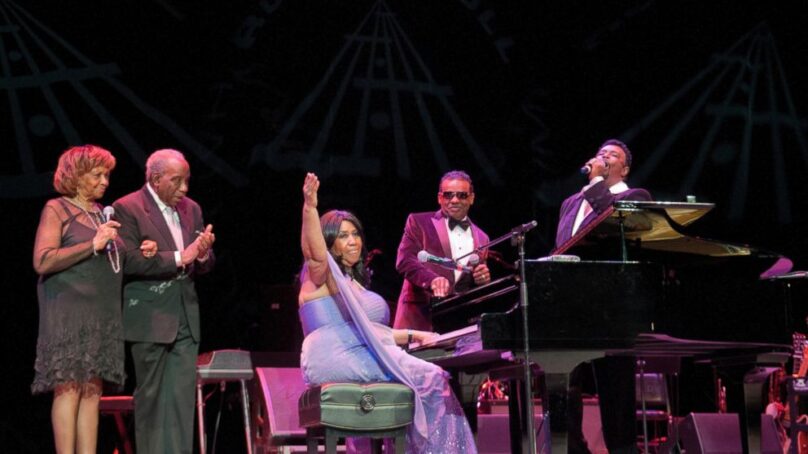
Aretha Franklin sang her first solo standing on a little chair, trembling, days after her mother died at 34. The song was Jesus, Be a Fence around Me. She was nine years old, asking God for the protection she just lost.
There was a rocking chair on the front porch at 21 Lyth Avenue in Buffalo, New York. Aretha Franklin spent summers there as a little girl, sitting on those steps in the Cold Springs neighbourhood, waiting for her mother to come home from work.
Barbara Siggers Franklin worked as a nurse’s aide at Meyer Memorial Hospital. She gave private music lessons on the side, and she worked at a music store because she had built a life from nothing after walking away from a man who could not stop breaking her.
People said Barbara abandoned her children. That story followed her like a shadow for decades, until Aretha herself set it straight.
Barbara did not abandon anyone. She left a husband whose infidelities were constant and public, a minister who had fathered a child with a twelve-year-old girl in his own congregation in Memphis.
Barbara moved to Buffalo in 1948, back to where her mother lived. The children stayed in Detroit with their father because that was how these things worked, because a mother leaving a preacher’s house did not get to take the preacher’s children.
But she visited Detroit to see them. She sent for them in the summers, and she never stopped being their mother.
When Barbara got home from the hospital at the end of a shift, she would sit in that rocking chair on the porch and pull her daughters close. She talked to them about better things to come.
Aretha remembered that porch, and the chair, and the sound of her mother’s voice after a long day. She wrote about it in her autobiography, decades later, as though the memory had never once dimmed.
On March 7, 1952, Barbara Siggers Franklin died of a heart attack at thirty-four years old. Her funeral was held at Friendship Baptist Church in Buffalo, and she was buried at Forest Lawn Cemetery while her sister-in-law described a room filled with stunned grief.
Aretha was nine. Her father’s booking agent, Ruth Bowen, said the girl could not speak for weeks.
C.L. Franklin told Bowen he was afraid Aretha would never recover. Something inside her had closed, and he did not know if it would open again.
It opened. But not with words.
Shortly after her mother’s death, Aretha stood up at New Bethel Baptist Church in Detroit and sang her first solo. She was trembling, standing on a little chair because she was too small to be seen over the pulpit.
The song she chose was Jesus, Be a Fence around Me. A girl who had just lost the person who rocked her on a porch in Buffalo stood in her father’s church and asked God to build a wall of protection around her.
She was asking for the thing her mother could no longer give. That request, sung in a child’s voice, would become the foundation of everything that followed.
Aretha Louise Franklin was born on March 25, 1942, at the family home on 406 Lucy Avenue in Memphis, Tennessee. Her father was a Baptist circuit preacher from Shelby, Mississippi, and her mother was a pianist and gospel singer whom Mahalia Jackson once called one of the finest in the country.
The family moved to Buffalo when Aretha was two, then to Detroit by the time she was five. C.L. took over the pastorship of New Bethel Baptist Church, and the Franklin household became a crossroads for some of the most important figures in Black America.
C.L. Franklin was brilliant, charismatic, and deeply flawed. They called him the man with the million-dollar voice, and he earned thousands of dollars per sermon.
He recorded over seventy albums of his preaching on Chess Records. Clara Ward, James Cleveland, Sam Cooke and Martin Luther King Jr all came through his home, drawn by the gravity of his presence.
But C.L. was also the man who had fathered a child with a twelve-year-old congregant named Mildred Jennings. He was the man whose infidelities broke his marriage and made Aretha’s mother disappear from the story so completely that most people believed she had simply walked away.
Aretha learned to play piano by ear in that house in Detroit. Nobody taught her, but by the time she was seven she could play as though she had been studying for years.
When she was twelve, her father began managing her career. He took her on the road with his gospel caravan, and she sang in churches across the country, a child performing alongside grown women who had spent lifetimes perfecting their craft.
She was also, at twelve, pregnant with her first child. His name was Clarence, named after her father.
The identity of the baby’s father remained unclear for decades. Aretha once said it was a classmate, but in a handwritten will found after her death, she named Edward Jordan.
Her second son, Edward, was born two years later. Both boys were raised in the Franklin home by Aretha’s grandmother Rachel and her older sister Erma while Aretha kept singing.
At fourteen, recording equipment was set up inside New Bethel Baptist Church, and Aretha recorded nine tracks for J.V.B. Records. The album was called Songs of Faith, and her voice already carried the weight of someone who had lived far longer than her years.
She spent summers on the gospel circuit in Chicago, staying with Mavis Staples and her family. She travelled with the Soul Stirrers and developed a crush on Sam Cooke.
By eighteen, she wanted what Cooke had already found, a way to carry the church into the world without staying inside it. She told her father she wanted to record pop music, and he let her go.
Columbia Records signed her in 1960, and she moved to New York. For six years, she recorded jazz standards, Broadway ballads, and pop songs that never quite fit.
The label did not know what to do with a voice that had been trained in the pews of a Detroit Baptist Church. They dressed her in arrangements that flattened her, smoothed over the thing that made her extraordinary.
In 1961, she married Ted White. He was older, controversial and her father did not approve.
White became her manager, and the marriage was marked by reports of domestic violence that Aretha rarely spoke about publicly. Some of her peers credited White for sharpening her career instincts, while others called him something far worse.
Everything changed in 1966, when Aretha signed with Atlantic Records and producer Jerry Wexler. He took her to FAME Studios in Muscle Shoals, Alabama, and for the first time on record, Aretha sounded like Aretha.
Respect was an Otis Redding song. Aretha turned it into something else entirely, adding the spelling, the demand, the structure of a woman who had been holding her tongue and was finished with it.
The song hit number one on both the pop and R&B charts. It became an anthem for the civil rights movement and the women’s movement simultaneously, because the word itself was big enough to hold both.
By the end of the 1960s, she had earned the title Queen of Soul. She won the first eight Grammy Awards ever given for Best Female R&B Vocal Performance, from 1968 through 1975, a streak no one has matched.
She released Lady Soul, Aretha Now, Spirit in the Dark, and Young, Gifted and Black in rapid succession. Each one was a document of a woman finding new rooms inside her own voice.
But here is the thing about Aretha Franklin that the hit records and the Grammy count do not tell you. She never stopped going back to the church.
In January 1972, at the age of twenty-nine, at the peak of her secular career, Aretha walked into the New Temple Missionary Baptist Church in Watts, Los Angeles. Atlantic Records thought she was making a mistake, but she did not care.
The album was called Amazing Grace. Reverend James Cleveland, a lifelong family friend, accompanied her on piano and directed the Southern California Community Choir behind her.
Her father was in the audience. He stood up during the second night and addressed the congregation, his million-dollar voice filling a room where his daughter was doing something he had trained her to do since she was a child standing on a little chair.
Aretha wore a white robe the first night and green paisley the second. She stood at the lectern or sat at the piano, her face glistening with perspiration, her hands sometimes clasped behind her back. She did not perform. She ministered.
Sydney Pollack filmed both nights, shooting twenty hours of footage on 16mm cameras. He had not used a clapperboard, so the sound and picture could not be synchronised and the film sat in a Warner Bros. vault for over thirty-eight years.
Aretha sued to block its release twice. It did not reach theatres until after her death, and when it finally screened at the New Temple Missionary Baptist Church in 2019, some of the original choir members were there, grey-haired now, some with oxygen tanks, sitting in the front rows.
Amazing Grace sold over two million copies. It remains the best-selling live gospel album of all time and the best-selling record of Aretha Franklin’s entire career.
Not “Respect.” Not “Think.” Not “Chain of Fools.” A gospel album, recorded in a church in Watts with a choir and a preacher and folding chairs.
Curtis Mayfield said it plainly. He loved her secular hits, but none of them reached the level of Amazing Grace and he called it her singular masterpiece.
Jerry Wexler, her producer, was an atheist. Even he compared the album to the Sistine Chapel.
In June 1979, C.L. Franklin was shot twice at point-blank range during an attempted robbery at his home in Detroit. A bullet severed an artery, limiting blood flow to his brain. He fell into a coma and never came out.
The Franklin children moved him home six months after the shooting and paid for twenty-four-hour nursing care.
The cost was twenty-five hundred dollars a week. They kept it going for years because they refused to let him disappear into an institution.
C.L. Franklin died on July 27, 1984, at sixty-nine. The same reverend who delivered his eulogy, Jasper Williams Jr, would deliver Aretha’s thirty-four years later.
Aretha kept singing. She signed with Arista Records in 1980 and found new commercial life with albums like Who’s Zoomin’ Who? And a number-one duet with George Michael.
In 1987, she became the first woman ever inducted into the Rock and Roll Hall of Fame. That same year, she returned to New Bethel to record her third gospel album in her late father’s church.
In 1985, the state of Michigan declared her voice a natural resource. Not a metaphor, not a figure of speech, but an official classification by the Department of Natural Resources, the same agency that categorised rivers and forests and mineral deposits.
She said she was delighted, being that she was a Michigan girl at heart. No one had ever received that particular honour before, and no one has since.
In the early 1980s, she hit severe turbulence on a small two-engine plane flying from Atlanta back to Detroit. She never flew again.
For the rest of her career, she travelled to every concert, every award show, every inauguration by bus. The Queen of Soul rode American highways because the sky had frightened her once and she did not give it a second chance.
She sang at Bill Clinton’s inauguration in 1993. She sang My Country, ‘Tis of Thee at Barack Obama’s in 2009, wearing a grey felt hat topped with a Swarovski crystal bow that the Smithsonian borrowed afterward.
In 1998, Luciano Pavarotti was scheduled to perform Nessun dorma at the Grammy Awards but cancelled because of a sore throat. The producers asked Aretha to fill in, and she had already performed the aria at a benefit concert months earlier, in her own key.
She walked onto that stage and sang one of the most demanding pieces in the entire operatic repertoire. A piece written for a dramatic tenor, delivered by a preacher’s daughter from Detroit, as though Puccini had composed it for her.
She gave money to the civil rights movement for decades. When Martin Luther King Jr needed funds, he called C.L. Franklin, and C.L. delivered Aretha.
She performed at benefits and covered payroll for civil rights organisations. She had toured with King since she was sixteen, and she sang at his funeral in 1968.
She provided ten-thousand-dollar checks to New Bethel Baptist Church several times a year. She sponsored Thanksgiving and Christmas meals for struggling families and arranged an annual concert at the church her father had built.
Aretha Franklin died of advanced pancreatic cancer on August 16, 2018, in Detroit. She was seventy-six.
Thousands lined up at the Charles H. Wright Museum of African American History to pay their respects. Stevie Wonder sang, Bill Clinton spoke, and Jennifer Hudson, whom Aretha had handpicked to play her in a biopic, performed.
In 2019, the Pulitzer Prize jury awarded her a posthumous special citation for her contribution to American music and culture over more than five decades. In 2020, a highway in Detroit was named in her honour.
But here is what stays with me. Before all of it, before eighteen Grammys and the Rock and Roll Hall of Fame and the Presidential Medal of Freedom, before Respect became a word that belonged to her, before she made an atheist compare a church recording to the Sistine Chapel, there was a rocking chair on a porch in Buffalo.
There was a woman who came home tired from a hospital shift and sat down and pulled her daughters close. She talked about better things to come, and then she died at thirty-four, and she never saw any of it.
And there was a girl, nine years old, who could not speak for weeks. Who stood on a little chair in her father’s church and trembled and opened her mouth and asked for a fence.
She spent the next six decades building one out of sound, out of breath, out of the gift her mother gave her before she left. The fence held.
It held through two difficult marriages and four children born before she was old enough to vote. It held through Columbia Records trying to make her something she was not, and through Atlantic Records finally letting her be who she was.
It held through her father’s shooting and his five years of silence and the twenty-five hundred dollars a week it cost to keep him breathing. It held through a fear of flying that kept her on the ground for thirty-five years.
Aretha Franklin’s voice was not just a natural resource of Michigan. It was the answer to a prayer she sang when she was nine, standing on a chair, asking to be kept safe in a world that had already taken the one person who made safety feel possible.
Barbara Siggers Franklin never heard Respect. She never heard Amazing Grace recorded in a church in Watts, never saw her daughter become the first woman inducted into the Rock and Roll Hall of Fame, never watched her sing for presidents or deliver an operatic aria meant for Luciano Pavarotti.
But she sat in a rocking chair and talked about better things to come. And every note Aretha ever sang was the proof that she was right.
- A Tell Media report / Source: Black History Archives


About author