



Italy thought they could trick Ethiopia into becoming a colony with mistranslated treaty. They didn’t count on the Empress who could read both versions.
May 2, 1889. The signing ceremony for the Treaty of Wuchale. Ethiopian Emperor Menelik II and Italian diplomat Count Pietro Antonelli sat across from each other, pens in hand, ready to formalise what Italy called a “treaty of friendship and amity.”
On paper, it looked straightforward: peace between Ethiopia and Italy, mutual cooperation, some territorial adjustments. Both sides would get what they wanted. Menelik signed the Amharic version. Antonelli signed the Italian version.
They shook hands. The Italians left satisfied. The treaty was done. Or so Menelik thought.
Standing behind the Emperor during those negotiations was Empress Taytu Betul – his wife, his closest adviser and the one person in the Ethiopian court who trusted Europeans least.
Taytu had watched the Italians operate for years. She’d seen them colonise Eritrea to the north. She’d watched them swallow most of Somalia. She knew exactly what Italy wanted: Ethiopia. And she knew that European powers didn’t sign “friendship treaties” with African nations they viewed as equals.
So when the Italians left and everyone in the Ethiopian court celebrated the new partnership, Taytu stayed suspicious. She demanded to see both versions of the treaty – the Amharic one Ethiopia signed, and the Italian one Italy would present to Europe. What she found was breath-taking in its audacity.
Article 17 of the Amharic version said Ethiopia could use Italian diplomatic assistance in foreign affairs if it chose to. Optional. A friendly offer between partners.
Article 17 of the Italian version said Ethiopia must conduct all foreign affairs through Italy. Mandatory. The language of a colony reporting to its master. The Italian version didn’t describe a partnership. It described a protectorate.
Italy had deliberately mistranslated the treaty to make Ethiopia a colony on paper – without Ethiopia even knowing it.
The Italians were planning to present their version to other European powers and say: “See? Ethiopia agreed to be our protectorate. It’s official. They signed it themselves.”
It was a con. A linguistic trap designed to steal a country. And Taytu was the only one who caught it. She was furious.
According to witnesses, when Taytu understood what Italy had done, she grabbed the treaty and tore it in half. Then she went to work convincing her husband – and the rest of the Ethiopian court – that they’d been played.
This wasn’t easy. Menelik had signed the treaty in good faith. He’d negotiated with the Italians for years, trading territory for firearms, trying to modernise Ethiopia’s military. He didn’t want to believe they’d betrayed him.
The Ethiopian court was divided. Some ministers thought Taytu was overreacting. Some thought confronting Italy would be too dangerous. Some just wanted to maintain the status quo. Taytu didn’t care. She knew what was at stake.
“You want other countries to see Ethiopia as your protectorate,” she told the Italian diplomats, “but that will never be.”
By 1891, the relationship had broken down completely. Menelik formally repudiated the treaty. He told Europe that Ethiopia was sovereign, independent and would not be anyone’s protectorate.
Italy was humiliated. Their scheme had failed. Their plan to colonise Ethiopia through paperwork had been exposed. And they blamed one person: Empress Taytu Betul.
Italian diplomats started describing Menelik as “weak, uncertain and in the hands of his wife.” They weren’t wrong. Menelik was in the hands of his wife. Good hands.
Taytu had been advising Menelik since they married in 1883. She was his third wife and unlike his previous marriages, this one was an equal partnership. Menelik consulted her on every major decision. He valued her intelligence, her political instincts, her ability to say “absolutely not” when he was inclined to say “yes, tomorrow.”
The Ethiopian court knew it. Foreign diplomats knew it. Everyone knew that if you wanted to negotiate with Ethiopia, you had to get past Taytu first. And Taytu’s answer to Italian colonisation was clear: No. War if necessary. But no.
In 1895, Italy invaded Ethiopia from their colony in Eritrea.
They expected an easy victory. African armies didn’t defeat European powers. That’s not how colonisation worked. Italy had modern rifles, artillery and military training. Ethiopia was outgunned and – according to European racist logic – inferior.
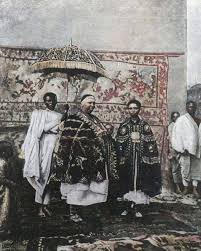
Italy was about to learn otherwise. Empress Taytu didn’t just oppose the war politically. She commanded troops in it. She led a force of 5,000 infantry and 600 cavalry. Her battalion included women fighters, escorted by men carrying red parasols to shade them from the sun – a striking visual amid the chaos of battle.
At the Battle of Mekelle, Taytu advised the Ethiopian general to cut off the Italians’ water supply, forcing them out of their fortified positions. She analysed intelligence gathered by Ethiopian spies -information that proved crucial to Ethiopian strategy.
She positioned medical units. She coordinated logistics. She made sure the Ethiopian army could strike where and when it chose, not where Italy expected.
On March 1, 1896, at the Battle of Adwa, Ethiopia crushed the Italian army. It wasn’t close. Ethiopian forces – over 100,000 strong, unified under Menelik and Taytu – overwhelmed the Italians. Italy lost thousands of soldiers. Thousands more were captured.
It was the most humiliating defeat a European power had suffered at the hands of an African nation during the entire Scramble for Africa. Ethiopia remained independent. The only African nation never colonised by Europe.
And it was Taytu who’d seen it coming. Taytu who’d exposed the treaty fraud. Taytu who’d rallied Ethiopia to fight rather than submit.
The Battle of Adwa sent shockwaves through Europe and across Africa. If Ethiopia could defeat Italy, maybe colonisation wasn’t inevitable. Maybe African nations could resist. The victory became a symbol – a proof of concept that European empires were not invincible.
Back in Ethiopia, Taytu’s influence only grew. She founded Addis Ababa, Ethiopia’s capital, in 1886 – choosing the location, naming it (it means “new flower”), and turning it into a permanent seat of power.
She financed the city’s first hotel. She advised Menelik on governance, diplomacy, and military strategy. She was, in every practical sense, co-ruler of Ethiopia.
When Menelik suffered a stroke in 1906, Taytu took on even more responsibility, essentially running the government as his health declined. But power made her enemies. Ethiopian nobles resented her influence. They plotted against her. In 1910, she was forced from power and eventually exiled to the old palace at Entoto, next to a church she’d founded years before.
Menelik died in 1913. Taytu lived quietly until 1918, when she died of heart failure at age 67.
Her name – Taytu, which means “sun” in Amharic – became her legacy. She’s still known as “the Light of Ethiopia.”
Because in 1889, when Italy tried to colonise Ethiopia through a mistranslated treaty, Taytu was the one who saw through the deception.
She read both versions. She caught the lie. She tore up the treaty. She rallied her nation to fight.
And when Italy invaded, thinking they could take Ethiopia by force, Taytu helped lead the army that sent them home in defeat.
Italy thought they could trick Ethiopia with paperwork. They thought African leaders wouldn’t notice. They thought they could rewrite a treaty and get away with it.
They didn’t count on the Empress who spoke their language – literally – and refused to be anyone’s colony.
- A Tell Media report / Source: The Way We Were


About author