


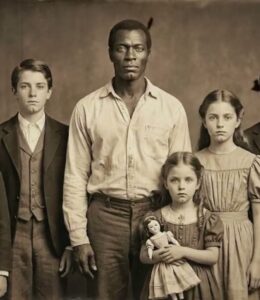
Virginia, 1852. A wealthy plantation master lies on his deathbed, surrounded by his seven beloved children. Their faces form a circle around him. Seven pairs of identical green eyes, seven cleft chins, seven striking profiles that mirror each other with uncanny precision. Robert Thornton gazes at them with fading pride, believing he sees his own legacy reflected back.
But down in the tobacco fields, a slave named Samuel pauses between the endless rows, staring toward the manor house on the hill, where those same seven faces, his faces, gather around a man who will die never knowing the truth. What Robert Thornton didn’t know would change everything his family believed about themselves for the next 150 years.
And the way this secret finally came to light will shock you more than the secret itself. This is not a story about scandal. This is about power, silence, and the dangerous architecture of denial that held together an entire society. What you’re about to hear actually happened on plantations across the American South, where the law itself made such secrets both possible and invisible.
Make sure you’re subscribed with notifications on because the moment those seven children realize the truth about their father, everything you think you know about American history gets turned upside down. The Thornton plantation stretched across 3,000 acres of Virginia’s Tidewater region in 1852. Robert Thornton had inherited this empire in 1829 along with 147 human beings recorded in ledgers as property.
Their lives reduced to dollar amounts and estimated productive years. Among them was Samuel, purchased at 19 and immediately sent to the field gangs where tobacco profits were extracted through brutal labour. He worked from sunrise until stars appeared, his hands permanently stained brown from tobacco leaves, his back bent over endless rows.
But Samuel was different in ways that should have raised questions. He stood six-foot tall with lean muscle and features unusual for the region. Vivid green eyes that seemed to burn with intelligence and a distinctive cleft chin like a thumbprint pressed into bone. His high, sharp cheekbones created a profile that white visitors occasionally remarked upon, though always carefully, always indirectly.
Robert Thornton spent months at a time in Richmond managing tobacco investments. His absences were constant, predictable, and long enough for other patterns to establish themselves back at the plantation. The fields where Samuel worked lay within sight of the mana house, separated by half a mile of gradual slope.
Catherine Thornton, left alone for months at a stretch, walked those fields more often than anyone recorded. And then the children started arriving. The first child, Thomas, came in 1833, exactly 9 months after Robert’s longest absence. Samuel knew the truth from the beginning, a truth he would carry in absolute silence for the rest of his life.
As Thomas grew past age three, the evidence became undeniable. His eyes shifted to that same distinctive green. The cleft appeared in his chin. His build developed lean and tall, matching Samuel’s exactly. Samuel watched his first child grow, unable to acknowledge him, understanding that even hinting at the truth would mean his immediate death. Six more children followed.
Catherine in 1835, Robert Jr in 1837, Elizabeth in 1839, Henry in 1842, James in 1845, and Margaret in 1847. Seven times Samuel felt the weight of unacknowledged fatherhood. Seven faces that carried his features while calling another man their father. Each child bearing identical markers, those piercing green eyes, those distinctive cleft chins, those sharp profiles.
Samuel watched every single one grow up knowing they were his while the law declared them property he would eventually be owned by. The knowledge became a kind of torture that had no name. He worked the fields and saw them playing near the manor house. He heard their voices. He watched Thomas, his firstborn, grow tall and strong, developing the same movements, the same unconscious gestures Samuel himself possessed.
He said nothing because speaking meant death. In the slave quarters, this reality existed as knowledge so dangerous that speaking it aloud could mean death, not just for Samuel, but for anyone who acknowledged it. Enslaved people watched young Thomas grow taller, noting how his profile matched Samuels with photographic precision.
They saw what everyone saw, but no one with power would acknowledge. Old Ruth, who had lived through three generations on the plantation, sometimes caught Samuel’s eye when the children were visible in the distance. She never spoke about what she saw, but her expression communicated understanding. She knew that he knew, and she knew the particular agony of watching your own children grow up as strangers.
The legal framework making this possible had existed since 1662. Partis Ventram, the child follows the mother’s condition. Children born to white mothers were white and free regardless of their biological father. This meant Catherine’s seven children with Samuel would be legally white, positioned as Robert’s heirs, entitled to inherit land and enslaved people, including their own biological father.
Samuel understood this with crushing clarity. His own children would one day own him. Thomas was already learning plantation management, preparing to assume control of everything, including the man who had actually fathered him. Robert Thornton looked at his seven children during his infrequent visits home and saw only his legacy.
He planned their futures with meticulous care, university for the boys, advantageous marriages for the girls. He never once noticed they all looked exactly like the field slave whose labour generated the tobacco profits sustaining everything the Thornton family possessed. But Samuel noticed everything he had to. By 1852, 19 years after the first child’s birth, Samuel had been living with this secret for nearly half his life.
Seven children, seven faces that mirrored his own. Seven lives he had helped create but could never claim. The weight of that unacknowledged truth had become so familiar it felt permanent, inescapable, defining. But someone else had noticed, too. And that person’s silence would cost more than anyone could have imagined.
Southern society in the 1840s didn’t just tolerate lies. It required them. The entire system of slavery depended on fictions so elaborate that generations participated in collective delusion without ever admitting what they were doing. The planter aristocracy built its world on myths they insisted were natural law. That slavery was benevolent, that racial hierarchies were divinely ordained, that white women embodied purity beyond question.
These myths required constant reinforcement through every aspect of daily life. In church sermons, in state laws, in plantation architecture itself. The manor house stood elevated with white columns visible for miles. Below sat the overseer’s cottage. Further down, slave quarters formed two rows of rough cabins.
The fields extended beyond where wealth was extracted from soil and humans suffering equally. Every inch reinforced a single message. Some people belonged at the top, others at the bottom, and the distance between them was natural and permanent. Robert Thornton believed this completely. He considered himself enlightened, providing adequate food, rarely using the whip, allowing garden plots.
He genuinely believed these concessions made him benevolent rather than simply a man profiting from owning humans. But Robert’s blindness wasn’t wilful. It was complete. When he looked at his children, his brain literally couldn’t process information contradicting his fundamental worldview. The green eyes, the cleft chins, the sharp profiles, all existed in a space his mind refused to access.
To acknowledge what he saw would require dismantling every belief giving his life meaning. Samuel, meanwhile, lived in a completely different reality. He saw everything because he had no choice but to see. Every time he glimpsed the children from a distance, every time he heard their names called, every time he worked near where they played, he experienced the dual consciousness of knowing they were his while being required to treat them as his master’s children and eventually as his own masters.
The psychological weight was almost unbearable. He knew Thomas was his son. Knew it the way any father knows his child through recognition existing in his bones. He counted them. Seven.
Seven children. Seven lives. He had helped create. Seven faces proving his fatherhood to anyone willing to look. But he also knew with absolute certainty that acknowledging this in any way would mean immediate death, not quick death.
- A Tell Media report / Source: Family


About author