

Sarah Forbes Bonetta was a Yoruba princess who became a diplomatic token in an empire that never asked her name.
She was born Aina around 1843 in southwestern Nigeria into the royal household of the Egbado, Yoruba people. Her early childhood was woven with ceremony, language, tradition – the textures of belonging that shape who you become. She was a child of status in a sophisticated kingdom with its own systems of power, art, trade, and governance that stretched back centuries.
Then the world ended.
During brutal regional conflicts that tore through West Africa in the 1840s, her village was attacked. Her family was killed. She was captured and sold into the slave trade, destined for ritual sacrifice in the court of King Ghezo of Dahomey – a common fate for war captives in that era’s political violence.
That’s where Captain Frederick Forbes found her in 1850.
Forbes was a British naval officer conducting diplomatic negotiations in Dahomey as part of Britain’s complicated relationship with West African kingdoms – relationships that mixed anti-slavery patrols with their own imperial ambitions.
When King Ghezo wanted to demonstrate goodwill toward British power, he offered Forbes a gift: a seven-year-old girl, eloquent and of royal birth, who would otherwise be killed. Forbes took her. Renamed her. Sarah, after his own family. Forbes, after himself. Bonetta, after his ship.
The girl who had been Aina disappeared into a new identity created by the men who controlled her fate.
Forbes brought her to England and presented her to Queen Victoria – not as a refugee, not as a survivor, but as a “gift” from an African king to the British Crown. A living symbol of imperial reach, packaged in the body of a traumatised child who spoke no English and had just watched her entire world burn.
Queen Victoria was enchanted.
She became Sarah’s godmother, a relationship the Queen took seriously in her own paternalistic way. She sponsored Sarah’s education at an elite boarding school, ensured she received instruction in English literature, music, French and all the accomplishments expected of a Victorian lady.
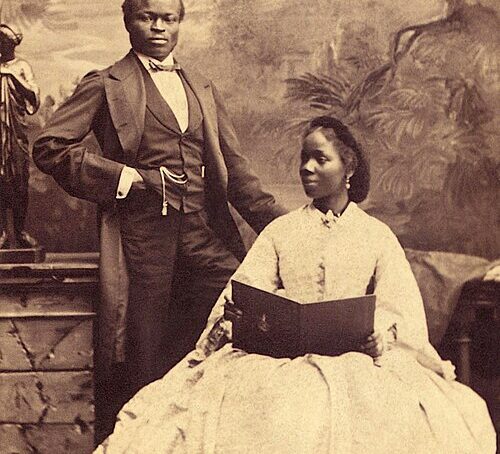
Portraits from this period show a poised young woman in elaborate dresses, perfect posture, intelligent eyes – a picture of successful “civilisation.”
But photographs lie by omission.
Those elegant images don’t show the profound dislocation beneath the silk and propriety. They don’t capture what it meant to be a princess in exile, celebrated as proof of British benevolence while simultaneously existing as evidence of British power. To be paraded in London society as both curiosity and symbol.
To carry the title of “goddaughter to the Queen” while knowing you were also called her “little African protégée” – a phrase that revealed exactly how the empire saw you.
Sarah’s health suffered in England’s cold, damp climate. The Queen, genuinely concerned, arranged for her to spend time in Sierra Leone – a British colony that served as a settlement for freed slaves and recaptured Africans. There, surrounded by other displaced West Africans rebuilding fractured identities, Sarah encountered echoes of the world she’d lost.
In 1862, at nineteen, Sarah married James Pinson Labulo Davies – a wealthy Yoruba merchant who had also been educated in Britain. It was a strategic match that allowed her to return to West Africa, to Lagos, to a life closer to her heritage. She had children. She built a household.
She maintained correspondence with Queen Victoria, dutifully naming her first daughter Victoria in the Queen’s honour – a gesture that carried layers of loyalty, obligation, and perhaps the complex affection that can develop even in unequal relationships.
But West Africa couldn’t heal what had been broken.
Sarah’s health continued to decline. Tuberculosis, the disease that killed so many in the 19th century regardless of status, ravaged her body. Seeking better climate for treatment, she travelled to Madeira, the Portuguese island often prescribed for respiratory illness.
She died there in 1880. Thirty-seven years old. Buried far from the Yoruba homeland she barely remembered and far from the English court that had claimed her.
Her daughter Victoria – named for a queen – later attended the funeral of that same Queen Victoria in 1901, completing a circle of imperial connection that stretched across generations and continents.
Sarah Forbes Bonetta’s story defies easy categorisation.
She wasn’t simply rescued – she was made into a project, a symbol, proof of concept for Victorian ideas about race, civilisation, and benevolent empire. But she also wasn’t simply a victim. Within the impossible constraints of her circumstances, she navigated multiple worlds with intelligence and dignity.
She maintained connections to Yoruba culture through her marriage and community. She raised children who carried both African heritage and access to British education. She corresponded with royalty as something approaching an equal, even as the fundamental inequality of their relationship was never in question.
To remember Sarah Forbes Bonetta honestly means holding all of these truths simultaneously.
It means seeing beyond the polished Victorian portraits to the seven-year-old girl dragged onto a ship, her name erased, her family murdered, her future rewritten by men who called it salvation. It means acknowledging that education and patronage, however genuine, cannot undo the violence of displacement.
That being called “goddaughter” by the most powerful woman in the world doesn’t make you less of a trophy, less of a diplomatic token, less of a living advertisement for empire.
But it also means recognising that Sarah lived with complexity that simple narratives of victimhood cannot contain. That she found ways to assert identity, maintain heritage, build family and exist as a full human being in a world determined to reduce her to a symbol.
Her life traced an arc through imperial violence disguised as benevolence, through cultural erasure masked as education, through the profound loneliness of being celebrated and displayed but never truly seen. And through all of it, she carried both her Yoruba heritage and her royal patronage with a dignity that the historical record, however incomplete, cannot erase.
Every portrait of Sarah Forbes Bonetta is haunted by her original name: Aina.
A name that belonged to a princess before she became a gift. Before she became a project. Before she became a footnote in Queen Victoria’s extensive correspondence about her many godchildren.
Aina, who would have lived a completely different life if violence and empire hadn’t rewritten her story in their own image.
That’s the name we should remember. Not because it erases the complexity of who Sarah became, but because it reminds us that before imperialism made her extraordinary, she was simply a child who deserved to grow up at home.
- A Tell Media report / Source: The Lost Chronicles


About author