

When former Baringo Senator Gideon Moi described the Luhyia community in western Kenya as “an elephant that does not know the value of its tusks,” he touched a raw nerve. The comment has reignited a long-running debate on failure of the community to make good use of its numerical and intellectual endowment to effect positive political and economic change in Kenya.
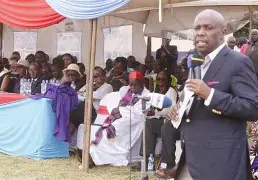
The statement was made during the burial of former minister and Lugari MP Cyrus Jirongo. It too soon class it political reawakening, but is a mirror that was being held in the face of cantankerous Luhyia leadership that often pursues tokenistic politics coated in “my people” populism.
It is an acknowledged fact that the East African nation is a Luhyia colony culturally – if culture is to be understood as a people’s way of life and a sum total of education, food, song and dance, belief system, naming system, sports and divinity. Save for politics and economy, Luhyia influence is felt in every cranny of the country.
However, the high level of education as reflected in skilled labour, numerical power and cultural dominance have never translated into political advantage. Instead it has bred servitude and dependency syndrome of unparalleled proportions.
For the record, this argument is premised on the controversial 2009 national population census and the 2012 study on household incomes by the ministry of national treasury and planning. Then minister for national planning Wycliffe Oparanya is on record about how h was arm-twisted to vary the 2009 census data that found the population of Luhyia to be 8,000,000 – 2,000,000 more than the Kikuyu of central Kenya.
The state reduced ‘recalibrated’ the census data to place Luhyia second to Kikuyu. The rigging may explain why the Somali numbers suddenly bulged.
During debate on the disputed census in parliament around March 2010, Oparanya told the House that he had been directed by then President Mwai Kibaki to “correct the anomalies” in the census that placed the Kikuyu behind Luhyia. The perceived “anomalies” nothing more than fears that the Luhyia numbers were more than the Kikuyu and would require a bigger share of national resource allocation. The numerical advantage meant more representation in the political sphere, therefore, more say in national resource allocation and sharing.
This is a public secret that dates centuries back when the British colonialist regime arid in Kenya – by extension East Africa – the only politically organised nation they found was Luhyia Kingdom that was personified by Nabongo Mumia of the Wanga Kingdom. Luhyia Kingdom was synonymous with Wanga Kingdom. The Luhyia Kingdom had devolved power that was exercised by vassal kings that were answerable to Nabongo Mumia.
At the advent of colonialism in the 1880s, the rest of present-day Kenyan communities were just bunches of warriors that fought over everything from livestock, women, hunting grounds, honey and grazing land, among other things.
Senator Moi’s elephant metaphor was loaded, but succinct. The statement: “The Luhyia are like elephants that have valuable tusks but they do not know their value” is a rebounding reminder of the deliberate economic and political isolation of the community.
As pointed out by Senator Moi, the time the Luhyia will realise the political and economic power they wield they will anchor Kenya on the road to rapid economic development and national cohesion. In truth, the parable is a political diagnosis that may not align with the manipulation of power-wielders that would the current confusion, which they exploit, prevails.
Founding President Jomo Kenyatta realised the power of numbers before he came to power. The colonial powers ensured the Luhyia subtribes were at loggerheads with each other though on the basis of their dialects. Jomo Kenyatta inherited this policy that has been sustained – sometimes overblown – to keep the community out of power. Kenyatta worried that the numerical advantage the Luhyia wield would keep the other tribes out of power. The arch-rivalry between the Maragoli and Bukusu, Wanga and Bukusu, best illustrate the hostility that was implanted in the Luhyia through political connivance.
It is therefore small wonder that the Luhyia were stereotyped as menial workers in spite of boasting the highest numbers highly educated professionals in Kenya. For instance a survey undertaken by former education minister Fred Matiang’i on ethnic composition of university staffing found that 65 per cent of university professors are Luhyia.
A study by Moi University Teaching and Referral Hospital psychiatrist and psychologist returned the verdict that Luhyia are victims of tor own positives. Their sense of modesty, live-and-let-live, sense of community (luyaa or vulala), divinity, family, discipline and ethics places them a cut above the rest. According to the researchers, these strong credentials elicit extreme jealousy that manifest in the form of negative profiling and stereotyping.
The Luhyia community is arguably Kenya’s largest voting bloc. Its spread is national unlike, say the Luo, Kalenjin or Kamba. Only the Kikuyu can match Luhyia in terms of national dispersion.
In democratic politics, numbers and knowledge are an irresistible currency. They are leveraged. They are a critical bargaining chip. These numbers are the metaphorical elephant tusks. Yet, in successive elections, this numerical strength has failed to translate into commensurate national influence, top-tier leadership positions or equitable resource allocation. The votes are present; the strategy is not.
At the heart of this paradox lies fragmented leadership. Like elephants without direction, Luhyia leaders often pull in different directions – each negotiating individually for personal survival rather than advancing a collective community agenda. This discompose undermines the community’s bargaining advantage and reduces its leaders to political spectators rather than power brokers.
The problem is compounded by cheap political trade-offs. Long-term political power is routinely exchanged for short-term gains, temporary appointments, handouts, tokenism or fleeting alliances. In the process, the community forfeits an opportunity to demand structural influence: control of key ministries, serious policy leverage or economic decision-making power.
Like in the wilderness where poaching is rife and elephants are hunted for their tusks, the Luhyia sunder their birth-right to political machinations. The Luhya community is ridiculed as a rich reservoir of kingmakers without kings. Its vote often determines who ascends to national power, but rarely does that power reside in the community itself.
This is what Siaya County Governor James Orengo spoke to during former minister Cyrus Jirongo funeral. Orengo was miffed by talk about Luhyia lacking a candidate with presidential credentials. Such talk is informed by low self-esteem that was inculcated successive colonial and post-independence administrations. Some people see the low self-esteem as a deliberate inferiority complex that has transformed in a hereditary feature of their life.
This dynamic invites external exploitation. Just as ivory hunters benefit from elephant tusks, external political actors benefit from Luhyia votes, labour and loyalty that is never requited. Divisions voting pattern – some se is a democracy – makes it easy for national leadership to take the community for granted.
Ultimately, this is also a loss of collective voice. When votes scatter across parties and personalities, no single, strong political voice emerges to demand accountability. Without unity, even large numbers speak softly, and power listens only to strength. Gideon Moi’s statement, therefore, is not an insult but a call to political awakening.
It urges the community to unite its voting patterns, strengthen internal leadership structures, negotiate from a position of strength rather than sympathy, and demand deliverables instead of promises.
In essence, the elephant is not weak. It is unaware of its power. Until the Luhya community recognizes the true value of its tusks and uses them strategically, others will continue to benefit more from its strength than the community itself.
- A Tell Media report / By Charles Jomo


About author