

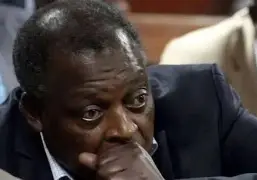
Like all historical personalities, fallen Cyrus Jirongo cannot “rest in peace”. Wrangles, contests and reviews of his life have characterised his death.
I suspect a succession hurdle lies in wait for obvious reasons. He is not alone in this.
Raila Odinga’s death sparked off a variety of reactions, some leading to deaths of around four people. Dr John Garang’s death in a helicopter crash en route to South Sudan from a meeting in Kampala, Uganda, occasioned the death of around 85 five people.
Garang’s grave has remained an active volcano as pan-Africanists seek explanation of his death. Perhaps the routine “rest in peace” send-off remark should be reserved for the ordinary.
Was Jirongo assassinated? That’s not my area of competence but Kenya’s history is replete with suspicious deaths through so called road and air accidents hence the legitimacy of people’s inquisitiveness.
However, knowing his character and spirit, Cyrus Jirongo possessed credentials that qualified him for an assassin’s eye. This is partially illustrated in my few encounters and covert dealings with him as you will witness below. We met in 1993 but let us fast-forward to 1995.
Two years after our encounter when I returned from exile in Libya, he told me a story:
“I want to tell you something I have never told anyone. When I was campaigning for Moi, a Central Province political operative cheated Moi that he was going to secure defections of key people from Mount Kenya. Moi gave him quite some money but he failed to deliver and was summoned to State House.
“After a private meeting with the Kikuyu guy and the president, I was asked to drive the fellow to his home escorted by the General Service Unit (GSU). In my vehicle, I was in the company of a certain Kalenjin Youth for Kanu member (William Ruto, now president).
When the Kikuyu fellow stepped out from my car, a GSU officer in the car behind me got out and shot him twice at point blank range at his gate. I nearly collapsed in shock. Then the same officer turned told me: “Ambia mtu yo yote juu ya hiki kitendo ndiyo ujue serikali ni nini.” (Leak information about this incident at your own peril).”
Jirongo told me these story in 1995 when we were driving to Nairobi to look for money to support Saulo Busolo’s parliamentary campaign in a Webuye constituency by-election in 1995.
In the morning, Busolo and I had secretly met Abraham Kiptanui, then State House Controller, at a carpentry workshop near Kunste Hotel in Nakuru after driving at night from Bungoma.
Our scheme as recommended by Jirongo was to secure the government’s non-interference undertaking in Webuye by-election by a false promise from our end that we would orchestrate mass defections after being elected. Jirongo presented the proposal to Kiptanui on our behalf. After a few questions, Kiptanui was convinced.
The State House Comptroller then said: “Can you talk to this Wafula Buke to ensure that the president is not stoned because President Moi is coming to Webuye to campaign for the Kanu candidate?”
“The Buke you are talking about is this one,” Jirongo pointed at me. Apparently they understood my role in what was going on the ground.
“You mean it’s you?” My clothes were not great. Kiptanui spoke in shock. He had a point. I was in charge of the “crude” wing of the campaign tasked to ensure that Kanu operations did not take place in Webuye. I must say we were thorough. The man we were campaigning against was my brother-law Joash Wamang’oli, the first cousin of Hellen Cherop’s mother.
I assured Kiptanui that the president will be safe. He offered to take us to meet Moi so that we could get campaign money but we told him that was not necessary since we were going to win the election.
“All we require from you is neutrality by the government after winning we shall come and join the president,” Busolo gave what sounded an assurance at the time.
“In the years that I have worked in government, I have never met anybody who refused to receive money,” Kiptanui said.
We were following the guidelines of Jirongo. “If you take their money and fail to deliver, they will kill you.”
Jirongo was applying the lessons he had learned from the Kikuyu conman who was shot in 1992.
I met Cyrus in 1993. I was taken to him by a man who later became my father-in-law. He informed me that Jirongo was dishing out money to opposition politicians after falling out with Moi and that I could try my luck since there were no serious integrity issues.
I was taken to him at Anniversary Towers, on University Way – directly opposite the University of Nairobi. The guys were excited to have recruited a rebel of my stature. Jirongo talked to me across his office table but my replies were not audible due to hunger. I was really, completely, thoroughly down financially.
The moral of my anecdote is Jirongo was a Walking Archive of political mischief in Kenya. He provide a glimpse of what he knew about the many economic crimes successive regimes had committed. In the last political rally addressed in Machakos in the company Wiper Democratic Front Kalonzo Musyoka, Jirongo was forthright that the clique that anchored Kenya on economic recession in 1992 via the infamous Goldenberg financial scam were fully in charge of the government.
He predicted that Kenya was on the road to even more devastating ruin under President William Ruto – his understudy in Youth for Kenya 1992 (YK92). It is not the first time he was making the comments.
With everything at stake in the 2027 presidential election such comments posed a threat to President William Ruto’s electability. Jirongo possessed the data capable of brining down any regime. It was obvious he was in the bull’s eye of the powers that be. An assassin need no second invitation.
- A Tell Media report / By Wafula Buke


About author