

Kenya has reaffirmed its strong commitment to advancing the country’s bio-economy, positioning the East Africa nation as a continental leader in science-driven, inclusive and sustainable development.
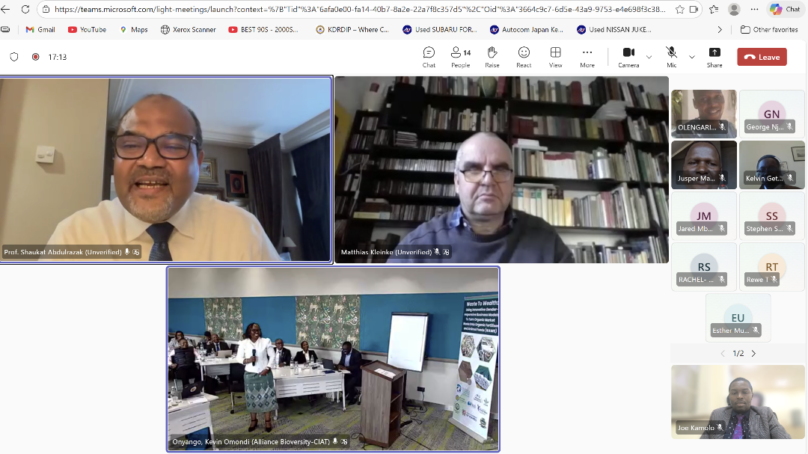
Speaking during the official launch of the Waste to Wealth (WAWE) project on Wednesday, Principal Secretary for State Department of Science, Research and Innovation Shaukat Abdulrazak said Kenya possesses the talent, institutions, scientific capacity and political goodwill required to lead Africa into a bio-economic future full of opportunity.
The launch served as a powerful reminder that Kenya does not have waste, but rather a vast national resource waiting to be transformed through science, innovation and collaboration. Prof Shaukat noted that projects such as WAWE demonstrate what is possible when scientific excellence is combined with community empowerment, sustainable enterprise and a clear national vision. He described the initiative as timely and visionary, standing at the intersection of science, environmental stewardship, economic transformation and social inclusion.
WAWE project brings together a diverse partnerships that include the Alliance of Biodiversity – CIAT, Pwani University, county governments and several national and international institutions. According to the principal secretary, this collaborative approach reflects the future Kenya is building – one where research institutions, communities and policymakers work together to unlock value from biological resources while addressing climate and development challenges.
Shaukat dismissed the conventional use of the word “waste,” introducing a new paradigm he termed the valorisation of valuable biomass residues. This approach, he said, is a central pillar of the emerging global bio-economy, which is rapidly gaining momentum across continents. Around the world, biology and regenerative resources are increasingly recognised as the foundation of the next frontier of industrial development, green growth and climate resilience.
He noted that the elevation of the bio-economy agenda at platforms such as the G20, COP30 and leading global science and climate forums is not accidental. Governments and institutions are acknowledging that bio-based innovations will define future industries. Kenya, he said, is deliberately positioning itself to be at the forefront of this transformation, both regionally and globally.
As Chair of Advisory Board of Bio-KE Project, Prof Shaukat expressed pride in the progress Kenya is making. He announced that Bio-KE is currently convening the National Bio-economy Strategy Working Group that is mandated to develop Kenya’s first-ever national bio-economy roadmap. This roadmap will guide the country toward an inclusive, green and knowledge-driven economy anchored in science and innovation.
He further revealed plans for a truly inclusive national bioeconomy conference, expected to bring together government, academia, industry, youth, farmers, and innovators. The conference will debate emerging opportunities and formally launch the Draft National Bioeconomyn Strategy for public participation. According to the PS, this will mark a historic milestone in Kenya’s science, technology, and innovation journey.
Shaukat said the WAWE project is within the broader national aspiration of the Bottom-Up Economic Transformation Agenda (BETA) and Kenya’s goal of becoming a first world country by 2050. He recalled that President William Ruto has clearly identified research, science and innovation as pillars of national transformation.
The bio-economy, he said, is one of the most powerful engines for delivering this transformation. It enables the conversion of biological resources into new industries producing bio-fertilisers, biogas, biochemical, biomaterials, green packaging and circular agriculture solutions. These industries, he added, are essential for job creation, industrial competitiveness and sustainable growth.
Kenya’s industrialisation, Shaukat observed, will not be powered by smokestacks alone. Instead, it will be driven by biology, innovation and the circular use of natural resources. For this reason, the government is deliberately integrating the bio-economy into national planning, county development priorities, climate resilience frameworks and industrial transformation strategies. In this context, WAWE is not merely a project but a practical demonstration of BETA in action.
No bio-economy can thrive without strong education, research and innovation systems. WAWE project plays a critical role in converting market residues and organic waste into affordable fertiliser, animal feed and climate-friendly products. In doing so, it addresses environmental challenges while building community-level green enterprises.
The project is also generating scientific evidence, strengthening youth and women’s participation in science-driven businesses, and advancing skills required for the future bio-economy. Shaukat noted that such initiatives transform students into innovators, farmers into entrepreneurs and universities into engines of national development.
Kenya is also asserting continental leadership through the Africa Bio-economy University Alliance, whose secretariat is hosted at Pwani University. The Alliance brings together progressive institutions from South, East, West and Central Africa, placing Kenya at the centre of a shared vision where African universities drive the continent’s green transition, circular economy and bio-based industries.
WAWE project embodies what Kenya needs for its future: science translated into enterprise, research translated into livelihoods and waste converted into wealth. Through gender-responsive business models, the project demonstrates how communities can reduce greenhouse gas emissions, counties can lower waste management costs, farmers can access affordable inputs and young innovators can build profitable and climate-friendly ventures.
This, Shaukat noted, is the future Kenya seeks – a circular, inclusive, bio-based economy rooted in local innovation and global best practice.
Kenya’s commitment to advancing the bio-economy is anchored in global, regional and national frameworks. These include the Eastern Africa Regional Bio-economy Strategy 2022-2032, the Global Bio-economy Summit 2024 Recommendations, FAO Bio-economy Guidelines 2024, G20 resolutions on bio-economy and the COP30 Bio-economy Challenge. Together, these frameworks guide Kenya toward a resilient, circular, climate-smart and research-driven economy that works for every citizen.
- A Tell Media / KNA report / By Joseph Kamolo Mutua


About author