
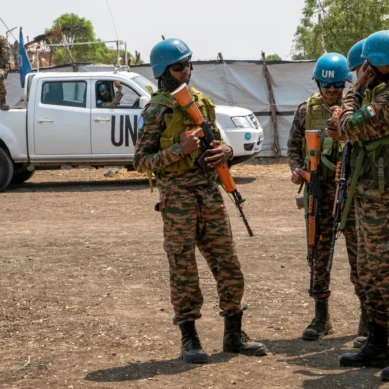

The first foreign boots since the UN approved a Gang Suppression Force (GSF) to tackle Haiti’s worsening security crisis have hit the ground but there’s little confidence among Haitians that it will be anything but yet another pointless foreign intervention.
A batch of 230 Kenyan police officers landed in the Haitian capital, Port-au-Prince, on December 8 – after the UN Security Council approved a resolution in late September to transition the Kenya-led Multinational Security Support (MSS) mission into the GSF.
Concerns that Haiti’s crisis could spill into the wider region led the UN, the Caribbean regional bloc (CARICOM), and the Organisation of American States (OAS) to multiply efforts to find new mechanisms to stabilise Haiti.
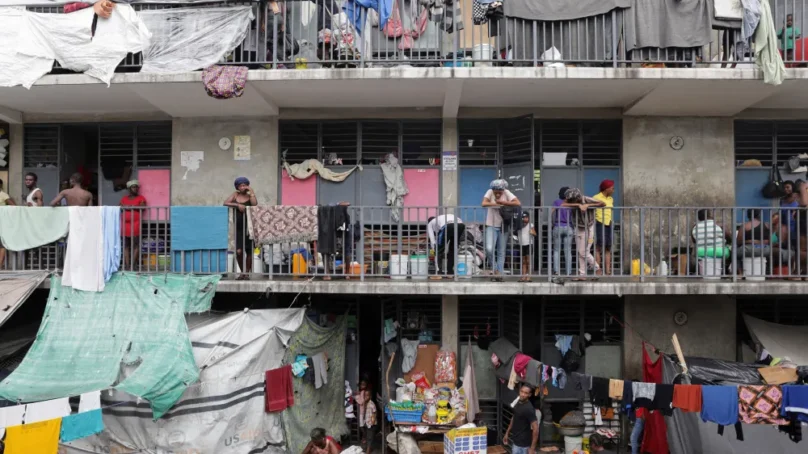
Gangs now control 90 per cent of the capital, 50 per cent of the surrounding Artibonite department, and continue to expand in other regions. More than 1.4 million people (more than one in 10 Haitians) are currently displaced, with little access to food, basic services, healthcare and education.
Slated to eventually include up to 5,500 police and military officers, the GSF aims to regain control of the country by fighting gangs through a broader and more combative mandate, while negotiations are continuing on the political front to pave the way for elections.
Observers fear the anti-gang mission will repeat the mistakes of the previous foreign intervention and could throw more fuel on the fire.
A nine-member Transitional Presidential Council (CPT) was established in April 2024 but instead of improving governance it has been embroiled in political infighting and corruption allegations, plunging Haiti into further chaos. Likewise, the MSS, which deployed in late June 2024 to restore security, has failed to quell the gang violence.
The mandate of the CPT is due to end on February 7, 2026. So far, it is unclear whether this mandate will be extended or if there will be another kind of transitional process.
A national decree has been signed scheduling Haiti’s first general elections since 2016 for two rounds in August and December 2026, but no one really knows what will be possible given the security crisis. The situation has been even more volatile since March, when Vectus Global, a private military company run by controversial US contractor Erik Prince, began launching drone strikes that have already been responsible for dozens of civilian casualties.
Earlier this month, seven Haitian citizens were interviewed – all but one of them displaced – to find out what they think of their country’s current situation and the new GSF. They described lives of desperation, exhaustion and hopelessness, and expressed little support for their current leaders or in a foreign intervention.
“They took everything from us, but we are still breathing”: Orné Derilia, a 45 year-old single mother of 10 living in the displacement camp at Argentine Bellegarde School.
I originally come from Carrefour-Feuilles [a neighbourhood southeast of Port-au-Prince]. I had a grocery shop and sold cooked food to earn my living. But the bandits set fire to my house and took everything I owned. Now, I find myself with nothing. I have 10 children [between 18 and 30 years old, some of whom she still cares for], I have four sisters and the bandits burned down their houses too. We are all homeless.
At the time of the first wave [of violence] in 2024, I decided to go and live in Samida [a part of Nazon, a central and densely populated area of the capital], but the bandits chased us away again. I was raped by gangs in Nazon, and had to come to the Argentine Bellegarde camp.
The rape was the worst thing that happened to me. I really feel bad about it; when I was a young girl, nothing like that happened to me and now that I am 45 years old, the bandits did this to me… it bothers me so much.
The situation in the camp isn’t good. I sleep on the floor. When it rains, my children and I can’t sleep at night because the place where we sleep gets flooded. We have to wait for the rain to stop so that we can dry the place and put the sheets back on to sleep.
Moreover, there are many cockroaches and bedbugs that prevent us from sleeping. And nights in the camp are very noisy.
Since I arrived at the camp, the only help I received, in 2024, came from the World Food Programme, which used to bring food and give us money. UNICEF also gave us cash. But now, we don’t receive anything – only water. My children and I have been left with nothing. When my neighbours cook, sometimes they give us some food.
We always hear that a force will come to fight the gangs, and then they disappear and nothing happens. It’s of no use to us.
Sometimes, I buy a bag of water and resell it to be able to feed my children. But at this moment, I’m broke. During the last hurricane [Melissa, in October and November], I was forced to spend all my savings to feed my children.
We always hear that a force will come to fight the gangs, and then they disappear and nothing happens. It’s of no use to us. Except for the drones that fall and cause fires, I don’t see anything.
When the drones fall, I am constantly afraid and they make a lot of noise. I tell myself that they are going to strike the gangs and that we will have a solution, but then we hear that the bandits are safe, and that, on the contrary, they are invading even more.
The day before yesterday, they kidnapped a young man from my neighbourhood and a policeman and they burned them [to death]. If the country has leaders at its helm, this should not happen. But in Haiti [politicians] are all the same: One day you see a president come to power, he takes office and does nothing. And then, it’s the same thing all over again.
It is the state’s fault that we are in such a situation. If our leaders were responsible people, we, the Haitian people, would not be in this situation… In other countries, presidents take care of their people, whereas in Haiti, the government does not value its own.
I want the state to allow me to leave this camp, where hunger gnaws at our stomachs and I have no one to turn to when I need help. The only hope I have left today is my breath. I am still alive, and it is by the grace of God. They took everything from us, but we are still breathing.
“I can see that we Haitians cannot bring about the change we want”: Lorvens Jean, a former teacher who is currently working as a motorbike driver but wants to join the Haitian National Police.
Things are deteriorating in Haiti, above all for the youths. There is no future for them. We suffer from too many shortages in this country. There is unemployment, insecurity, a lack of schools, no roads, and so many other things. The situation is really difficult for many people, if not everyone.
I believe that Kenyans [from the MSS] aimed to provide support to legal forces but time has passed and I don’t see any change.
The Gang Suppression Force is a beautiful initiative; if there is will and the necessary means, it could lead to a change because insecurity is today’s biggest issue. If that is addressed, things will automatically be different… We can’t solve the current situation through dialogue; any dialogue is impossible. People often say that when a young person is used to carrying guns it will be difficult to take them away from them. That’s why we need some kind of repression to obtain the results we want.
If I could pass a message to gangs, I would remind them that we are all Haitians.
So, I agree with the presence of a foreign force. It isn’t a new idea: They have been talking about it for four or five years. I can see that we Haitians cannot bring about the change we want. If we can get the support from others, then so be it. And we will have to accompany them in their work.
If some people start working tirelessly right now, we could talk about having elections in two or three months, so that the country starts functioning again. Because if we’re always going to have provisional governments that last three or six months it’s a complete waste. It is a means for [those in power] and their family to get rich; it won´t solve any issue.
We would have been better off without the Transitional Presidential Council. They brought no improvement; it’s gone from bad to worse.
I don’t have children yet but I wouldn’t wish my children to go through what I have experienced. And I hope that those involved will show a sense of patriotism. Let us love our country, think of the people and the future of our youth for the good of the country.
If I could pass a message to gangs, I would remind them that we are all Haitians. I understand that they find themselves in this situation because of frustrations or because they lost someone close to them. But let’s be conscious… Lay down your arms. Too much blood has been shed, we’ve had too many dead, we have gone through too much.
- A Tell Media report / Adapted from The New Humanitarian


About author